
Jeudi 4 juin 2026 (10h-12h)
Intervenant·es :
Justine Louis (CEVA), Alix Levain (CNRS, EMR POSSEA-AMURE), Sylvain Ballu (CEVA), Hervé Squividant (Institut Agro, UMR SAS)
Résumé :
Les premières occurrences de marées vertes sont un sujet d’intérêt pour une grande diversité d’acteurs sociaux, dont certains ont pu collecter des informations destinées à conforter des hypothèses fortes sur leur caractère très ancien et leur naturalité ou, au contraire, la brutalité de leur surgissement, en lien avec les changements majeurs ayant affecté les infrastructures paysagères et les pratiques agricoles dans la période qui le précède immédiatement.
S’ajoutent, sur la longue durée, des évolutions des enjeux associés à cette datation : en particulier, dès lors que l’implication des acteurs publics dans la lutte contre les marées vertes est abordée avec un point de vue critique et a fortiori par le prisme de l’exposition des populations à un risque sanitaire, la mise en évidence de l’installation du phénomène sur le temps long, ainsi que la recherche de sources montrant l’écart entre la détection du phénomène, la formalisation des alertes, et une forme de prise en charge publique, maintiennent la question de l’”origine” des marées vertes à l’agenda.
La datation précise des premières occurrences d’efflorescences massives d’algues, et en particulier des ulves, sur les sites repérés et suivis par le CEVA depuis sa création en 1982, est ainsi à la fois un enjeu scientifique et politique. C’est aussi un défi méthodologique, qui implique de croiser différents types d’expertise, pour développer une approche critique de sources aussi diverses que des témoignages, des photographies aériennes, des articles de presse ou des études scientifiques.
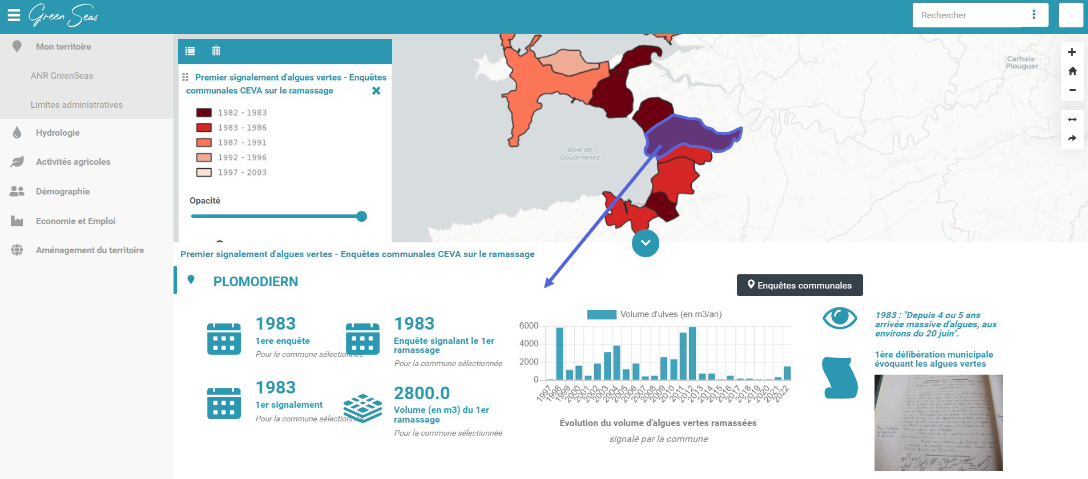
Dans ce contexte et dans le cadre du projet GreenSeas, le chantier engagé par le CEVA, AMURE et l’Institut Agro autour de la datation vise d’une part à contribuer à l’analyse rétrospective intégrée de la trajectoire des socio-écosystèmes vulnérables à l’eutrophisation côtière, et d’autre part à consolider et publiciser le travail de datation de l’ “origine” des marées vertes. La participation des trois équipes de recherche au projet constitue une opportunité inédite pour croiser les sources hétérogènes collectées par le passé et construire ainsi des interprétations plus robustes des traces de blooms anciens, mais aussi pour explorer de nouvelles sources, produites par d’autres institutions et/ou témoins du phénomène.
A l’occasion de cette première restitution, le groupe de recherche interdisciplinaire « Datation » (Justine Louis, Alix Levain, Sylvain Ballu, Hervé Squividant) a présenté les méthodes de collecte et d’analyse des sources qu’il a mobilisées, les premiers résultats et la façon dont ils seront rendus accessibles à un public élargi. Pour voir ou revoir cette séance ou les suivantes, rendez-vous sur la chaîne Canal U du projet GreenSeas!
Abstract :
The earliest occurrences of green tides are a subject of interest to a wide range of stakeholders, some of whom have gathered information intended to support strong hypotheses regarding their ancient origins and natural character or, conversely, the suddenness of their emergence, linked to major changes that affected the landscape and agricultural practices in the period immediately preceding them.
In the long term, there are also evolving issues associated with this dating: in particular, when the involvement of public actors in the fight against green tides is approached from a critical perspective and, a fortiori, through the lens of the population’s exposure to a health risk, the demonstration of the phenomenon’s establishment over the long term, as well as the search for sources showing the gap between the detection of the phenomenon, the formalization of alerts, and some form of public response, keep the question of the “origin” of green tides on the agenda.
The precise dating of the first occurrences of massive algal blooms, and in particular of Ulva, at sites identified and monitored by the CEVA since its creation in 1982, is thus both a scientific and political challenge. It is also a methodological one, requiring the integration of different types of expertise to develop a critical approach to sources as diverse as eyewitness accounts, aerial photographs, news articles, or scientific studies.
In this context and as part of the GreenSeas project, the initiative launched by CEVA, AMURE, and the Institut Agro on dating aims, on the one hand, to contribute to the integrated retrospective analysis of the trajectory of socio-ecosystems vulnerable to coastal eutrophication, and, on the other hand, to consolidate and publicize the work on dating the “origin” of green tides. The participation of the three research teams in the project presents a unique opportunity to cross-reference the diverse sources collected in the past and thus construct more robust interpretations of traces of past blooms, as well as to explore new sources produced by other institutions and/or witnesses to the phenomenon.
On the occasion of this first presentation, the interdisciplinary research group “Dating” (Justine Louis, Alix Levain, Sylvain Ballu, Hervé Squividant) presented the methods used to collect and analyze the sources they have mobilized, the initial results, and how these will be made accessible to a wider audience. To watch or rewatch the session, visit the GreenSeas project’s Canal U channel!